


Agency capacity planning directly affects whether your agency makes money or burns through it. In our 2025 survey of 2,000 UK agency workers on overworking and burnout, 95% reported working overtime and 38% had experienced burnout in their current role.
And, 41% of those burned-out workers pointed to high workloads as the cause. That’s a capacity planning failure, not just a culture problem.
Get planning right and you protect margins, keep teams productive, and deliver for clients on time. Get it wrong and you end up with overworked staff, missed deadlines, and clients who stop calling back. Let’s get into it.
In this article 📖
What is agency capacity planning?
Agency capacity planning is the process of matching your available resources (people, skills, equipment, budget, and time) to current and forecasted client demand. In other words, it’s the process of answering the question, “Are the right people and resources available, and do you have enough of them?”
Capacity planning differs from general resource planning in scope.
Resource planning covers the broader allocation of people, time, budgets, and tools across all work.
Capacity planning focuses specifically on whether your team has enough bandwidth to take on and deliver client projects without overloading them, or leaving people idle.
When capacity planning works well, it helps agencies forecast staffing needs before gaps become emergencies. Overallocation is one of the earliest warning signs that something’s off.
Further reading: Explore our guide to spotting and preventing burnout to avoid the damage it can cause when left unchecked.
Why does agency capacity planning matter?
Agencies that plan capacity well tend to run leaner, deliver more consistently, and retain staff longer. These three outcomes of agency capacity planning matter most.
- Optimized utilization rates. Capacity planning helps you assign the right people to the right projects while preventing overloading or underutilizing employees. Agencies should typically target 70-80% billable utilization. Below that range, you’re leaving money on the table. Above it, you’re burning people out
- Fewer bottlenecks and less rework. Allocating resources based on actual availability and skills prevents the scramble that happens when three projects hit the same designer in the same week.
- Stronger margins. Inefficient use of resources and cost overruns shrink when you plan capacity properly. You get better project cost estimates upfront, which means more accurate scoping and pricing. Also, without proper tools, waste compounds. Our 2025 survey found that 38% of agencies still manage resources in spreadsheets, which makes overallocation and scheduling conflicts far more likely.
Further reading: Check out our guide to improving your agency’s efficiency through resource planning.

What types of agency capacity planning are there?
Depending on your size and project mix, you can approach capacity planning from different angles.
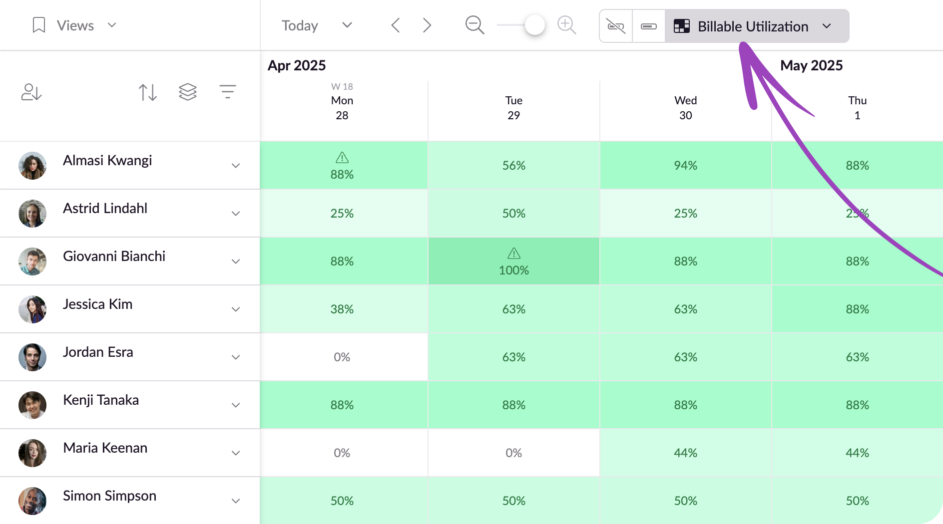
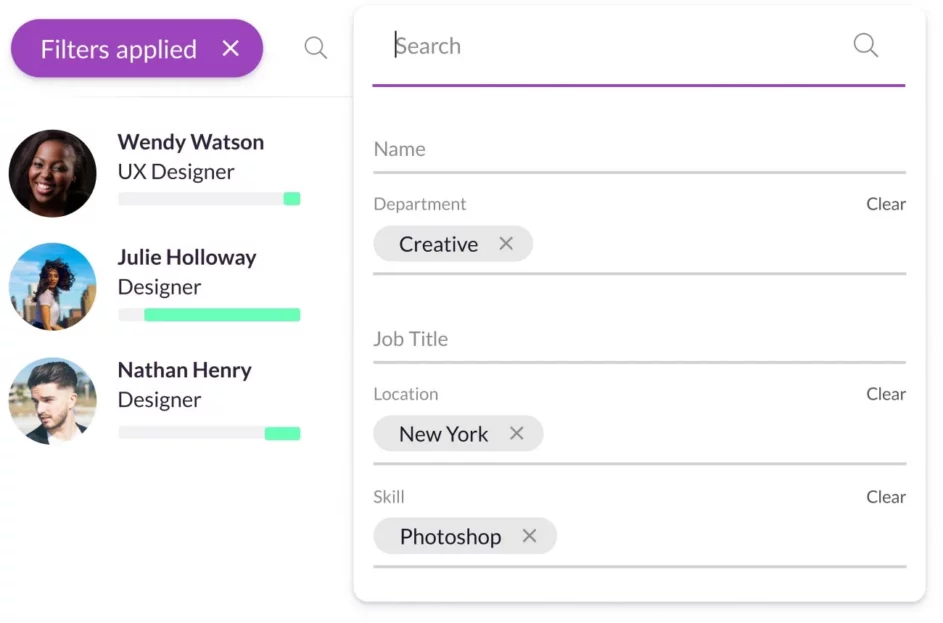
Further reading: Explore our guide to finding the right agency team structure to learn how to do it right. Resource-based agency capacity planning. Agencies assess their available resources, including employees, skills, and equipment. For most agencies this is the natural starting point because headcount is the primary constraint. Track all of these with our equipment management software alongside people and skills to see your full capacity for taking on new projects. Project-based agency capacity planning. Agencies plan capacity project by project, assessing the resource requirements of individual projects and allocating resources accordingly. This works well when projects vary in size and complexity, because blanket allocation wouldn’t account for the difference between a two-week landing page and a six-month platform build. Client-based agency capacity planning. Agencies allocate resources based on client priority or account value. High-value clients or long-term contracts receive priority in resource allocation. Your biggest retainer and a one-off project don’t deserve the same share of your best people’s time. Time-based agency capacity planning. Time-based capacity planning focuses on scheduling people and resources over specific time periods, such as daily, weekly, monthly, or quarterly. This is how most agencies actually operate day to day, even if their strategic planning is resource- or client-based. Growth-based agency capacity planning. Growth-based capacity planning aligns capacity with long-term objectives. It involves evaluating resource needs over an extended period, and making strategic investments in talent and infrastructure. Note that this approach only works when your pipeline data is reliable enough to plan against. Bonus resources: Three core strategies from operations management theory govern how agencies respond to changes in demand. Most agencies use a mix—depending on the situation—but understanding the tradeoffs helps you decide which to lean on. 👉 See how dedicated resource management for marketing agencies handles unpredictable workloads. Retainer-heavy agencies with predictable revenue often lean toward lead. Agencies with variable, project-based workloads and tighter cash tend toward match. Agency capacity planning isn’t a one-off exercise. It involves several steps to get resources allocated efficiently, and it requires ongoing monitoring as client needs and project demands change. Begin by mapping your agency’s current people and resources. Build a skills matrix that shows each team member’s capabilities and current allocation percentage. Without this baseline, every decision downstream is a guess. Don’t assume your team has spare capacity just because nobody’s complained. In our 2025 survey, 88% of agency workers reported working weekends. If your assessment doesn’t account for overtime that’s already baked in, you’re measuring capacity that doesn’t really exist. Further reading: Dive into our guide to finding the right agency tools for your planning needs. Gather information on current and anticipated client demands. Engage with sales and account management to get the full picture of what’s in the pipeline, but separate confirmed work from speculative opportunities. Weight pipeline by probability rather than treating every prospect as guaranteed. A 60% likely project at £50K contributes £30K to your demand forecast, not £50K. Agencies that forecast on unweighted pipeline consistently overcommit, and overcommitment is where burnout starts. 👉 See how creative agencies forecast and manage client demand using Resource Guru. Define what you’re trying to achieve with capacity planning in measurable terms. Vague goals like “improve resource allocation” don’t give you anything to track against. Strong capacity planning objectives look like: “reduce average overtime hours from 12 to 6 per person per month”, “bring billable utilisation within the 70-80% target band”, or “cut emergency freelancer spend by 30% over the next two quarters”. These are specific enough to know whether your planning is working or not. Billable utilisation is the single most important metric. Professional services firms typically target 70-80%, and SPI Research’s 2026 benchmark of 500+ firms found the highest performers consistently achieved substantially higher utilisation through better workforce planning. But don’t stop there. In our 2025 agency survey, 37% of burned-out workers admitted making mistakes and 32% delivered lower quality work. Error rates and quality dips are leading indicators that utilisation alone won’t catch. Our free resource capacity planning template covers the core metrics to start tracking. Analyze billable utilization rates in Resource Guru. Score each project on revenue impact, strategic value, and resource fit. A £20K project that requires your only senior developer for six weeks has a very different capacity cost than one you can staff from your bench. Rank accordingly. Projects scoring high on revenue but low on resource fit need freelancer support or a delayed start, not blind optimism. Advertising agencies that prioritise project resources effectively build this scoring into their pipeline reviews. Match skills and availability to project requirements, allocating to high-priority work first. Watch for two failure modes: overloading your best people because they’re good at everything, and underusing specialists whose skills don’t match the current pipeline. Check both: is anyone above 85%? Anyone below 50%? In our 2025 agency survey, 55% of burned-out workers had taken time off as a result, creating the absence spiral that makes capacity worse. Resource Guru’s capacity planning software helps you spot these patterns before they compound. An example of an agency workload planning tool with filters for skills and team capacity. Filter by skills in Resource Guru and assign the right people to your projects. Review at team level weekly, individual level monthly. If anyone is above 85% for two consecutive weeks, that’s an overallocation signal, not good productivity. Solving resource overallocation early is cheaper than dealing with the fallout. By the time symptoms show up, the problem has been building for weeks. In our 2025 agency survey, 33% of stressed workers lacked motivation, and another 33% were procrastinating or getting distracted. Model three scenarios each quarter: a major client increases scope by 30%, you lose your largest account, and two team members leave in the same month. For each, document the utilization impact, the contingency, and the response time. Make sure your traffic managers are involved and learn to communicate resource constraints before they escalate. Factor in new pressures too. Our 2025 agency survey found that 20% of workers say AI has actually increased their workload. Client expectations around AI output are creating hidden demand that won’t appear in your project plans, unless you look for it. Cross-team resource sharing fails when ad-hoc requests are factored in, because team leads protect their best people. Fix it structurally: make allocation data visible to all managers and tie sharing decisions to capacity review meetings. When sharing is planned and transparent, it stops feeling like a favour and functions as normal operations. Reducing the risk of team burnout depends on workloads being balanced across the agency, not just within individual teams. Overpromising kills projects and client relationships. In our 2025 agency survey, 36% of workers said they’d quit due to stress. When overcommitment drives staff turnover, you pay twice: recruitment costs and disruption to live work. Flag capacity constraints before they become delivery risks. PMI’s 2025 research found organizations with strong stakeholder management see scope creep on 28% of projects vs. 40% for those without. A structured agency client onboarding process sets those expectations from day one. Run a quarterly capacity retrospective. What did you forecast? And what actually happened? Where did you overcommit, and where was there idle capacity? Track the delta between planned and actual utilization each quarter to calibrate future forecasts. Refining your agency processes depends on this feedback loop. “Agencies often think they have a workload problem when what they really have is a visibility problem. The ones that get capacity planning right build it into their operating rhythm, not treat it as a one-off exercise.” Capacity planning improves when you measure it. Four practices make the biggest difference: Put employee wellbeing first. Consider your team’s workload when planning resource allocation. Overburdening employees leads to burnout and decreased productivity, so tracking overtime hours and flagging anyone consistently above target utilization is essential. Our guide to improving agency work-life balance can help you take control before burnout becomes a problem. Streamline processes with tools. When you’re dealing with multiple projects there’s nothing worse than managing capacity planning in a spreadsheet. Our 2025 survey found 38% of agencies still do exactly that. The right tools give your team visibility into who’s working on what and where the gaps are. Read our comparison of the best resource management tools to find the right fit. Hold regular capacity reviews. Schedule meetings with department heads, project managers, and traffic managers to review resource allocation. This is when you look at project progress and adjust based on current priorities. 👉 See how Havas CX Canada manages agency capacity planning in our interview with their team. Create a capacity buffer. Maintain a buffer in your resource planning to accommodate unexpected resource needs or changes in project scope. Further reading: Read our guide to preventing scope creep before it derails delivery. Spindogs is a full-service digital agency delivering bespoke solutions for global clients across housing, education, automotive, and professional services. With a growing team and increasing client demand, the agency had hit the limits of managing capacity in Google Sheets. According to Program Manager Hannah Cook-Fuller, keeping track of work across projects had become “impossible”, and the team had no clear picture of billable time or future capacity. After moving to dedicated capacity planning tooling, Spindogs saw immediate results. According to Hannah, “We are not overbooking, and we are actually creating breathing room in the workday which was invisible before.” The team now forecasts using real utilisation data, has increased the amount of billable time logged, and saves hours every week that previously went to manual reporting and ad-hoc resource requests. Read the full Spindogs case study to see how they made the switch. Agency capacity is calculated using the formula: Available Capacity = Team Members x Working Hours x Utilisation Rate. Ten people at 37.5 hours and 75% utilisation gives you 281 billable hours a week, minus leave, bank holidays, and internal projects. In our 2025 survey, 95% of agency workers reported overtime and 88% worked weekends, which means many agencies are running on borrowed capacity they haven’t measured. Resource Guru’s capacity planning software calculates this from your team’s actual bookings. Agencies should hire when a role is consistently overloaded for three consecutive months, signalling sustained demand rather than a spike. Patching sustained demand with overtime instead of headcount shows up in absence and attrition. For short-term spikes, freelancers are lower risk because you avoid fixed costs against uncertain work. Our guide to agency growth covers when to scale permanently versus temporarily. Agencies should plan capacity across three horizons: weekly for live allocation and overload checks, monthly for pipeline conversion, and quarterly for hiring and strategic shifts. PMI’s 2025 research found organisations with strong planning skills see scope creep on 28% of projects vs. 40% for those without. Weekly plans should be accurate to the hour; quarterly plans are directional, based on weighted pipeline and historical patterns. Our workload planning guide covers how to run this cycle. Capacity planning for remote or hybrid agencies follows the same principles but requires stronger visibility tools, because you can’t see who’s drowning and who’s idle. In our 2025 survey, 60% of agency workers reported stress and 33% lacked motivation, signals that are harder to catch across distributed teams. If your team spans multiple time zones, reduce your effective capacity estimate for cross-timezone projects by 10-15% to account for shrinking collaborative hours. See how agencies track and manage capacity across distributed teams. Capacity planning isn’t a one-time fix. It requires constant monitoring, adjustment, and buy-in across leadership, project managers, and department heads. Start with the 11 steps above and track your utilization. Browse our agency resource hub for guides, templates, and case studies to keep improving. If you’re ready to move capacity planning out of spreadsheets, Resource Guru gives you a single view of team availability, utilization, and project schedules. Join thousands of project managers who have made scheduling a breeze.Which agency capacity planning strategy should you use?
How to do agency capacity planning in 11 steps
1. Assess current resources
2. Understand client demand
3. Set clear objectives
4. Identify key metrics
5. Prioritize projects
6. Allocate resources
7. Review utilization
8. Scenario plan for changes
9. Share resources across teams
10. Communicate with clients
11. Monitor and improve

What should agencies track to improve capacity planning?
What does agency capacity planning look like in practice?
Agency capacity planning FAQ
How do you calculate agency capacity?
When should an agency hire instead of using freelancers?
How far ahead should agencies plan capacity?
How does capacity planning work for remote or hybrid agencies?
How better capacity planning supports agency profit

The #1 scheduling tool trusted by thousands of project teams