The project life cycle is the series of phases a project passes through, from the first idea to final handover. This project management life cycle consists of five main phases: initiation, planning, execution, monitoring and controlling, and closure.
This article will cover what’s involved at each stage and how to transition from one to another smoothly. First, though, some context.
This guide is for project managers, studio managers, operations leads, and resource managers. It covers each phase, the gate that closes it, and how to handle capacity shifts along the way.
The main problem a healthy project life cycle solves is project slippage. Typically, unrealistic deadlines get set long before the work starts, so it’s important that every step of the life cycle is a well-oiled machine. Just look at data from The State of (Over)working 2025, and you’ll see 33% of UK desk workers who ended up with burnout blamed deadlines like this.
This article aims to cut that issue off at the source with practical ways to ensure each phase of each project not only protects its profitability, but the people delivering it.
In this article 📖
The project life cycle, at a glance
- The project life cycle is the series of phases a project moves through, from first idea to final handover
- Most guides (including ours) recommend five phases: initiation, planning, execution, monitoring and controlling, and closure
- Each phase ends at a gate, a sign-off that helps you decide whether the project is ready to move on to the next phase
- Resource and capacity needs peak in execution, so we recommend planning capacity by phase before each one starts
- Choose the life cycle type by how clear your scope is. We include multiple examples and use cases for your convenience
Expert input: Yad Senapathy
For this article, we spoke with Yad, a project management veteran (and self-styled PMP Jedi Master), to understand his approach to the project life cycle. Here’s a little more about him:
Yad Senapathy, MS, PMP, is the Founder and CEO of the Project Management Training Institute (PMTI), North America’s leading PMP certification boot camp, which he co-founded in Dallas, Texas, in 2003.
Over more than two decades, PMTI has trained over 80,000 professionals to earn their PMP certification, maintaining a 99% exam pass rate. Enterprise clients include Amazon, General Dynamics, Booz Allen Hamilton, Adobe, Genentech, L3Harris, and the U.S. Air Force.
What is a project life cycle?
To understand what “project life cycle” means, it’s important to be familiar with a few related concepts.
As we mentioned at the start, the project life cycle is the series of phases a project moves through from start to finish.
We define a project itself as a temporary effort to create a unique product, service, or result, which means it always has an end and phases in between.
The project management life cycle, specifically, describes how you manage that journey, from the first idea to final handover.
Most project life cycles share six traits:
- A defined start and finish
- Objectives set at the beginning
- A plan for reaching them
- Deliverables and tasks to complete
- A way of managing the work
- A list of stakeholders
In the following sections we’ll break the cycle down into its distinct phases and then dig into each in detail.
The phases of a project life cycle
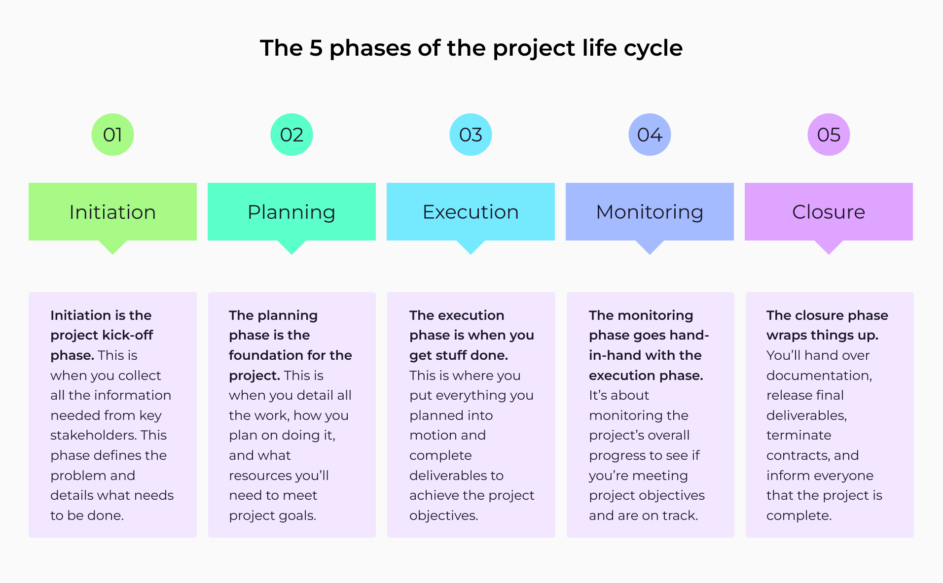
The project life cycle has five phases, and each one ends at a “gate”. The diagram below shows the order, and the sections after it cover what happens in each phase, what you deliver, and what decisions happen at each particular gate. The table at the end of this section sums it all up.
Phase 1: Initiation
The initiation phase is where an idea gets turned into an approved project. Ideally, in this phase, you write the project charter, which sets objectives and scope, and you list the stakeholders. You should also test feasibility and build the business case, weighing benefits, costs, and risks.
Our guide to project initiation has the full checklist, and our guide to roles and responsibilities can help you decide who does what.
Some additional steps that can help in this phase are creating a rough demand forecast and performing a skills check. These involve figuring out how many people the project will this need, and whether everyone has the necessary skills or experience. Answering those questions at this stage stops you from promising work you can’t staff adequately.
The key deliverable in initiation is a signed project charter. The exit gate is sponsor sign-off. In a 60-person agency, the sponsor is often a founder or director. In a larger organization, it might be a COO.
PMI’s Pulse of the Profession 2026 lists sponsor alignment at initiation among the practices high performers use more than low performers. PMI reports that 39% of high performers use it, against 30% of low performers.
Here’s a first-hand recommendation too:
“Ensure project scope, success criteria (including what is not in scope), key project dependencies, budget (agreed with the sponsor), and authority to make changes are all agreed before commencing work on a project. It is important to define success and agreement upfront.”

Phase 2: Planning
Project planning is the second phase of the project life cycle. It sets the baseline that every later phase is measured against. A solid project plan covers:
- Scope, objectives, and deliverables
- Schedule and dependencies
- Budget
- Risk plan
- Communication plan
- Quality plan
This description is intentionally high-level because there are many different approaches. However, our step-by-step guide to creating a project plan goes deeper, and a free project plan template can offer you a solid start.
Resourcing in this phase means building the capacity plan, which should include who specifically is available, with which skills, across the weeks the plan covers. Resource allocation, which puts named people on tasks, is just one component of that work.
The key deliverable at the end of this phase is the approved project plan. The exit gate is stakeholder approval.
Phase 3: Execution
Execution is where most of the actual work gets done i.e., where the team produces the deliverables. The project manager briefs people, coordinates the schedule, and keeps the client or internal stakeholders informed through regular reviews. Our guide to project execution covers the day-to-day and is helpful if you’re looking for a more thorough walkthrough than we can fit in this section.
This is also the stage where resource demand peaks. Most of the billable hours and most of the clashes happen here. A deadline that made sense in the plan gets tested the first time someone is out sick or a client review overruns.
Delivery data shows how often that causes knock-on effects. In Wellingtone’s State of Project Management 2026 report, only 36% of organizations mostly or always complete projects on time.
The key deliverable of this phase is the finished work, ready for review. The exit gate is the client or sponsor accepting the deliverables.
Phase 4: Monitoring and controlling
The monitoring and controlling phase runs alongside execution. During it, you track budget, utilization, and scope against their baselines, then course-correct if you spot any issues.
Our guide to monitoring and control covers the metrics you should keep an eye on in detail, though you should always reference the specific metrics/KPIs agreed at the start of each project. At this stage, you should also factor in the time needed for reporting on all the above.
For reference, per Wellingtone’s 2026 report, 72% of project professionals said they spend half a day or more each month collating reports.
As you progress, you will also liaise with your client or other stakeholders, and may have to deal with additional requests. At this point it’s important to check and reference the agreed project scope.
One small change is fine if you log it and approve it but a string of them can lead to scope creep, which can cause massive delays if left unresolved. When a change is necessary, make sure to update the baseline and the schedule together so the plan stays accurate.
The key deliverables at this stage are variance reports and approved change requests. The exit gate is passed once variances are back within tolerance, or stakeholders approve a new baseline.
Phase 5: Closure
Project closure involves handing the work over and getting the team ready to start on their next project. Therein, you typically deliver final documents and deliverables, close contracts, release people back to work on new initiatives, and run a lessons-learned review. Our guide to project closure and closure checklist cover each step.
One important tip for this phase: Record actual hours before everyone moves on to the next project. In The State of (Over)working 2025, 46% of desk workers said they don’t use any timesheet software but, without actuals, your next project estimate is just conjecture, and is far less likely to be accurate.
With real actuals from timesheet entries, you estimate from data. That gives you the confidence you need to defend your recommended timeline, and to request any additional people or resources to get the work over the line.
The key deliverables at this stage are the handover pack and the lessons-learned report. The exit gate is formal sign-off.
Project life cycle deliverables and phase gates
Use this table as a checklist for the product of each phase, and what has to be true before you and your team can move on to the next phase.
Phase | Key deliverables | Exit gate | Resourcing decision |
Initiation | Project charter, business case, stakeholder list | Sponsor signs off the project charter | Rough demand forecast and skills check |
Planning | Project plan, schedule, budget, risk plan, communication plan, quality plan | Stakeholders approve the baseline | Capacity plan built, then named people allocated |
Execution | Finished deliverables, status reports, client review notes | Client or sponsor accepts the deliverables | Utilization tracked and work rebalanced as it changes |
Monitoring and controlling | Variance reports, approved change requests | Variances back within tolerance, or a new baseline approved | Work reallocated when variance appears |
Closure | Handover pack, closed contracts, lessons-learned report | Delivery lead and sponsor sign off, and the project is archived | People released back to the schedule and actual hours recorded |
How resource and capacity needs change across the project life cycle
Whatever project lifecycle management software you use, someone has to answer one question before every phase: do we have the people? To get a good answer, you should consider capacity by phase. Capacity by phase just means baking capacity planning into each stage. To do that, you forecast the people and skills a phase needs, then check that against who’s available before it starts.
Here is how capacity by phase plays out:
- Initiation. Make a rough demand forecast and a skills check
- Planning. Build the capacity plan, then allocate named people
- Execution. Track utilization and rebalance workloads as work shifts
- Monitoring and controlling. Reallocate as soon as variance appears
- Closure. Record capacity lessons, such as what the project really took and where capacity ran short.
“Resource problems happen when you’ve scheduled the same specialist to work on multiple projects around the same time. Checking their availability, when you need their involvement and if other teams/projects need their expertise can highlight issues early on.”
Running several teams or offices? Add up capacity by phase across every active project, and you can see where the same people are wanted twice, long before clashes land.
Resource Guru’s capacity planning software shows who’s over- or under-utilized, lets you map unconfirmed work against tentative bookings and placeholders, and flags clashes.
The #1 scheduling tool trusted by thousands of project teams
Join thousands of project managers who have made scheduling a breeze.
Types of project life cycles
The five phases are the same across projects, but you can run those phases in different ways, and each way is a project life cycle type. Choosing between them generally depends on how clear your scope is. Check out the table below for which type suits which level of scope clarity you’re dealing with.
Type | How the phases run | Best when | Example |
Predictive (waterfall) | You plan everything first, then run each phase once, in order | Scope, schedule, and cost are fixed and well understood | A building fit-out or an offshore wind design package, where design is approved before construction starts |
Iterative | Phases repeat, and feedback after each round reshapes the next | The goal is clear but the solution is not | A consultancy's process redesign, where each workshop's findings shape the next round |
Incremental | The project ships in sets, and each set runs through the phases in order | Value can be delivered in usable pieces and delivery timing matters | A software integration released module by module |
Agile (adaptive) | Initiation happens once, then planning, execution, and control repeat in short cycles with feedback | Scope is unclear, feedback is essential, and requirements will change | Creative production in two-week sprints |
Hybrid | Predictive where scope is fixed, adaptive where it is still forming | Part of the work has fixed constraints and part needs flexibility | A multi-channel campaign with a fixed launch date and sprint-based asset production |
A hybrid life cycle combines predictive and adaptive approaches in one project. The parts with fixed scope, dates, or budgets follow a predictive plan, and the parts where requirements are still forming run in short iterations. Our guide to project methodologies covers each approach in more depth.
Project life cycle example: A multi-channel agency campaign
All the details we’ve covered up until now are as practical as possible, but it can often help to see a worked example of the project life cycle to make the whole process easier to understand.
For this one, imagine a 90-person agency running a multi-channel launch campaign for a client on retainer. We’ll use the hybrid life cycle: predictive at each end, agile in the middle.
- Initiation. The client’s brief includes a fixed launch date and budget. The sponsor signs the charter once a skills check confirms the agency has the staff it needs
- Planning. The team baselines scope, schedule, and budget. They build the capacity plan first, then assign named people to the schedule
- Execution. Creative production runs in two-week sprints, with client feedback after each one. But, there’s an issue. Demand peaks, and in sprint three the same two designers are booked on the campaign and on another client’s pitch
- Monitoring and controlling. The clash shows up on the schedule before the sprint starts because the bookings were visible on the schedule. The project manager then moves the pitch work to a freelancer and updates the plan
- Closure. The client accepts the final assets on delivery. The team records actual hours spent, allows the team to move onto new projects, and runs a lessons-learned review
Further reading: Our guide to the agency project management process goes into more depth on how different agencies can adapt the project life cycle to their specific needs.
Critical success factors across the project life cycle
Every project is different, but every successful project has a few things in common. Thankfully, once you’ve familiarized yourself with these best practices, you set yourself up for a higher chance of delivering work on time, and on budget:
- Clear, measurable objectives. Set them at the initiation phase, with a number and a date, so everyone knows what “done” actually means
- A structured framework. In PMI’s Pulse of the Profession 2026, 72% of projects using a framework were considered successful, against 61% with no structured approach. Yet 35% of project professionals used no framework on their most recent complex project
- Gates every team respects. Agree the exit criteria for each phase so every project in the organization closes a phase for the same reasons
- Scope control. Check each change request against what was agreed up front before you commit to it
- Capacity by phase. Review capacity at the start of each distinct phase to prevent schedule slips
- Open communication. Share status and variances with stakeholders as they appear, not at the next gate
And, it doesn’t hurt to get a pearl of wisdom from someone who’s been in the project management game for over two decades. Here’s Yad’s top tip for closing out the project life cycle strong:
“At closure, I pay particular attention to the estimates that were wrong and why they were wrong. I want to know: Which of our estimates were way off and why? How did late-breaking information, slow approvals, or other delays impact the schedule?”
Frequently asked questions about the project lifecycle
What is project life cycle management?
Project life cycle management (sometimes styled as “project lifecycle management”) is the practice of guiding a project through each necessary phase, with defined deliverables, gates, and capacity checks. Organizations running many projects often assign it to a PMO.
What is the difference between a project life cycle and a project phase?
A project life cycle is the full sequence of phases from start to finish. A project phase is one stage within it, such as design or build, and each ends with a deliverable and a gate.
What is the difference between PMLC and SDLC?
PMLC, the project management life cycle, covers how you manage any project from initiation to closure. SDLC, the software development life cycle, covers how software gets built specifically. A software project often applies the stages in both cycles.
Make every stage of the project life cycle manageable with software built for change
Throughout our discussion of the project life cycle, we mentioned how important data accuracy and change management are. What we didn’t go into in depth is where you can keep track of that.
Resource Guru is resource management software that automatically detects clashes before they become blockers, makes changes seamless (even at the last second), and gives deep capacity insights at a glance.
Try it yourself for free to see how it can support you, at every stage:

The #1 scheduling and time tracking tool trusted by thousands of project teams
Join thousands of project managers who have made scheduling a breeze.
Last updated: 10th November, 2026.