A project lead guides the delivery of a project, workstream, or project team. Depending on the organization, they might coordinate day-to-day work, lead a team, manage risks, report to stakeholders, or take responsibility for a particular part of a larger project.
The tricky part? “Project lead” doesn’t mean exactly the same thing everywhere.
Some organizations use “project lead” and “project manager” interchangeably. In others, a project lead focuses on a team or workstream while a project manager has broader responsibility for the overall project.
And, contrary to a common misconception, the difference isn’t whether someone has a PMP certification. Professional certifications can strengthen your project management credentials, sure, but they don’t determine your job title.
Here’s a TL;DR of what we’ll cover in this article to help demystify the life of a project lead:
In this article 📖
Project lead: key takeaways
- A project lead typically combines hands-on project delivery with team leadership
- Project lead responsibilities vary considerably between companies and industries
- A project lead may report to a project manager, work alongside one, or take broader responsibility for the project
- A project manager is more consistently associated with responsibility for overall project delivery, including areas such as scope, schedules, resources, budgets, risks, and stakeholders
- Neither project lead nor project manager is the more senior title by default—it depends on the organization
- You don’t need PMP certification simply to be called a project lead or project manager
What is a project lead?
Generally speaking, a project lead is someone responsible for leading the delivery of a project, a workstream within a project, or the team carrying out that work.
As well as the whole “project manager vs. project lead” distinction we already touched on, you might come across alternative titles like:
- Project leader
- Project team lead
- Project management lead
… and so on. To understand how each one differs, you need context, because different organizations use them in different ways.
The Project Management Institute (PMI) defines a project manager as the person assigned to lead the team responsible for achieving the project’s objectives. The Association for Project Management (APM) describes the project manager as the individual responsible for successful project delivery.
When you look at definitions by company rather than industry bodies like these two, there’s even more variation.
Per the Valve handbook, their project leads are explicitly not treated as traditional managers. Given the company’s flat structure, the person acting as a project lead is more of a central coordinator for the project than someone with formal authority over the team.
In the GitLab handbook, meanwhile, “project lead” carries more concrete operational responsibility. Its Tableau project leaders are responsible for validating content and data, and maintaining security and governance standards. That goes way beyond the traditional “make this project work somehow” mandate.
In other words, the project lead title tells you something about the person’s leadership role, but you need to look at actual responsibilities per organization to understand where they sit in the project structure.
In the next sections, we’ve looked at additional industry research and spoken to current project leads to better understand the nuances.
What does a project lead do?
A project lead helps turn a project plan into actual work. As a result, typical project lead duties include:
- Setting priorities for the project team
- Coordinating tasks and deliverables
- Tracking milestones and deadlines
- Identifying risks, issues, and blockers
- Keeping stakeholders updated
- Coordinating people and other resources
- Maintaining the quality of project deliverables
- Helping the team solve problems
- Reporting on project progress
- Supporting or contributing to project planning
- Leading and motivating the people doing the work
There’s plenty of overlap here with traditional project management, which can be a source of confusion.
For example, US occupational data from O*NET shows just how broad project delivery work can be. Among its highest-rated tasks for Project Management Specialists are communicating with stakeholders to understand requirements, identifying required resources and staffing, maintaining the quality of deliverables, solving project problems, and planning or scheduling activities to meet deadlines.
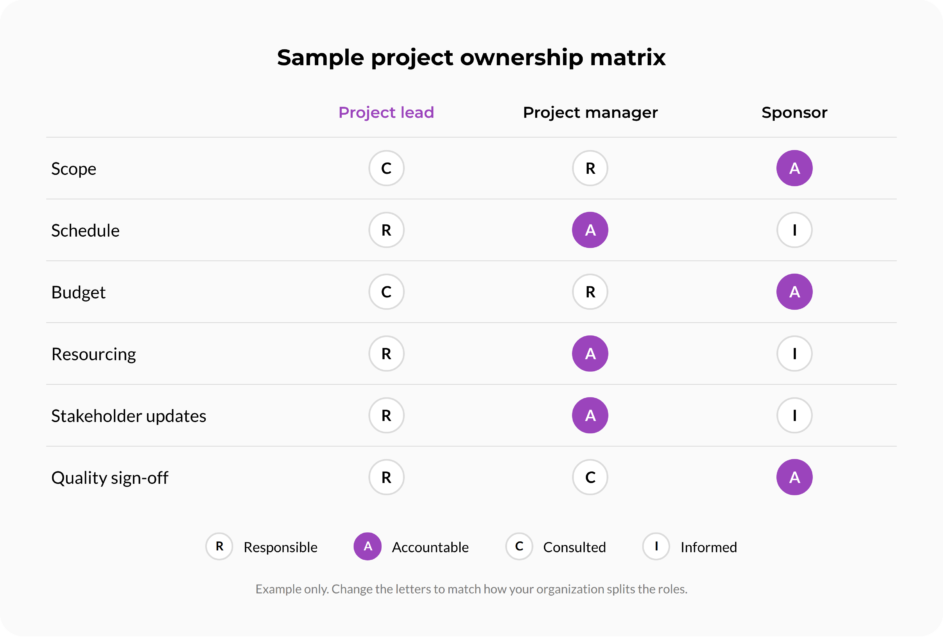
The exact mix will depend on your company. That’s why one of the first things any project team should do is get clear on who owns what.
If nobody knows whether the project lead, project manager, or someone else owns a decision, you’ve already created a pretty good recipe for delays.

Plan with Gantt charts. Deliver with smart scheduling.
Join thousands of managers using Resource Guru to plan projects and schedule people in one place.
Project lead vs. project manager: what’s the difference?
The simplest way to think about the project lead vs. project manager distinction is this:
A project lead often focuses closely on leading delivery, a team, or a specific workstream. A project manager is more commonly responsible for managing the project as a whole.
But that’s a generalization—not a universal rule.
Professional frameworks tend to give project managers fairly broad accountability. The UK Government’s Project Delivery Capability Framework, for example, describes the project manager as responsible for leading the project and project team day to day and overseeing delivery against agreed time, cost, and quality constraints. The framework also covers responsibilities including budgets, resources, governance, and stakeholders.
A project lead’s remit is much more dependent on how the individual organization designs the role.
Here’s how the roles often compare:
Area | Project Lead | Project Manager |
Primary focus | A project, team, workstream, or area of delivery | The overall project |
Day-to-day delivery | Often highly hands-on | Usually oversees delivery across the project |
Team leadership | Common | Common |
Project planning | May own or contribute to plans | Typically responsible for the overall plan |
Scope responsibility | Varies | Often broader |
Budget responsibility | Varies significantly | More commonly part of the role |
Resource scheduling | May manage team/workstream schedules | Typically oversees the overall schedule |
Resource management | Coordinates resources needed for their area | Typically responsible for project-wide resource requirements |
Stakeholder management | Communicates with relevant stakeholders | Usually has broader stakeholder responsibility |
Reporting line | May report to a project manager or another senior leader | Often reports to a sponsor, PMO, or senior management |
PMP required? | No | No |
The important word to keep in mind here is “typically“.
Your organization could define the two roles completely differently.
That’s why a job description is much more useful than a title when you’re trying to understand someone’s actual level of responsibility.
Is a project lead higher than a project manager?
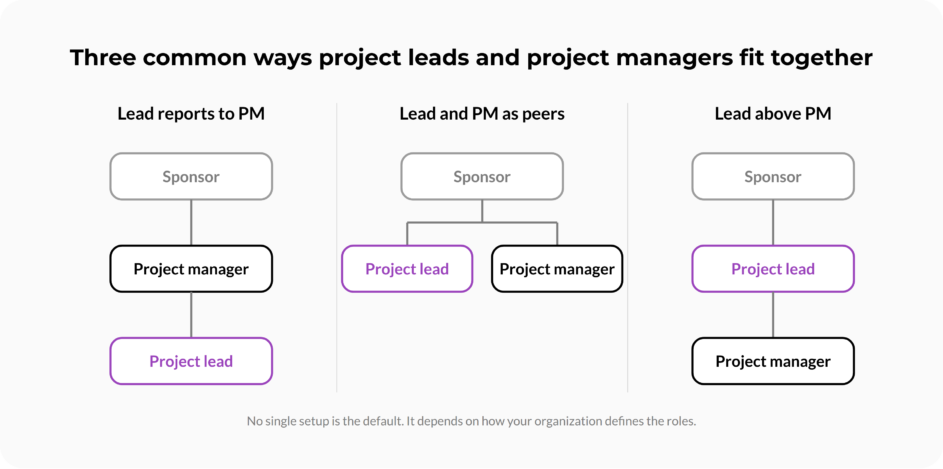
Not necessarily. A project lead isn’t automatically above or below a project manager.
In some organizations, the project lead owns a smaller project or individual workstream and reports into the project manager.
In others, the project lead might be the senior person responsible for the direction of the work, with a project manager handling more of the planning and coordination.
And some companies simply choose one title over the other.
Real-world job descriptions show this variation clearly. For example, Torbay Council’s project lead role includes leading operational change projects, coordinating other people’s work, tracking timelines, and managing risks—but it doesn’t carry direct budget responsibility. The UK Space Agency’s definition gives its project lead responsibility for communicating progress across areas including technical delivery, risk, budget, and schedule.
So if you’re deciding whether a project lead or project manager is more senior in your company, look at:
- The scope they own
- Decision-making authority
- Budget responsibility
- Number and seniority of people they lead
- Stakeholder accountability
- Who they report to
- Who is ultimately accountable for project outcomes
The title alone won’t give you the answer.
Project lead roles and responsibilities
So, what might you actually find in a project lead job description?
Let’s break the main responsibilities down.
1. Team leadership
A project lead needs to give the team enough direction to move the work forward.
That might involve:
- Setting priorities
- Allocating tasks
- Clarifying responsibilities
- Removing blockers
- Facilitating decisions
- Giving feedback
- Keeping the team focused on project objectives
Leadership doesn’t necessarily mean formal line management, either. Project teams are often made up of people from different departments, disciplines, agencies, or even companies.
That means project leads frequently need to get work done through people they don’t directly manage.
2. Project delivery
Ultimately, project leads are there to help the project deliver what it promised.
They’ll commonly track:
- Tasks
- Milestones
- Dependencies
- Deadlines
- Deliverables
- Risks
- Issues
- Changes to the plan
If something starts slipping, the project lead needs to identify it quickly, understand why it’s happening, and work with the right people to fix it.
3. Stakeholder communication
Projects can get complicated fast when information doesn’t travel with them.
A good project lead makes sure the people involved understand:
- What’s happening
- What’s coming next
- What decisions need to be made
- What has changed
- Which risks have appeared
- Where support is needed
That might mean running project meetings, producing status reports, talking directly to clients, or escalating an issue to the project manager or sponsor.
4. Risk and problem management
Almost no project goes exactly to plan.
People get pulled onto other priorities. Scope changes. Deadlines move. Suppliers let you down. Something that looked straightforward turns out to be anything but.
Project leads need to identify those risks and problems early—and avoid waiting until they become full-blown project emergencies.
That means continually asking questions such as:
- What’s likely to stop us hitting this milestone?
- Which assumptions are we relying on?
- Are any resources becoming overloaded?
- Are dependencies on track?
- Does this change affect our timeline or scope?
- Who needs to know about this?
5. Resource management and scheduling
A brilliant project plan isn’t much use if the people needed to deliver it aren’t actually available.
Project leads may need to:
- Identify the skills required
- Check who’s available to do the work
- Allocate tasks or bookings
- Track team capacity
- Spot scheduling conflicts
- Balance project demand against other commitments
- Rework the plan when priorities change
O*NET identifies resource and staffing needs, scheduling work, and assigning responsibilities among core project management activities.
For project leads, good resource visibility can be the difference between discovering a capacity problem several weeks in advance and discovering it the day before a deadline.
6. Quality assurance
Getting something done isn’t the same as getting it done well.
Project leads often help make sure deliverables meet the agreed requirements and quality standards before they’re handed over to a client, stakeholder, or another team.
That can involve:
- Agreeing acceptance criteria
- Reviewing work
- Coordinating testing or QA
- Checking deliverables against requirements
- Addressing gaps before sign-off
7. Budget and cost awareness
This is one responsibility that varies particularly widely between project lead positions.
Some project leads directly manage a project or workstream budget. Others simply need to understand how their decisions affect costs and report issues to the project manager.
Don’t assume that someone owns the budget just because they’re called the project lead.
Make it explicit.
What skills make a good project leader?
Project leadership needs more than knowing how to create a Gantt chart.
The best project leads combine planning and delivery skills with the ability to bring people together when projects get messy.
Here are some of the most important project leader skills.
Leadership
You need to create direction without trying to control every detail.
Good project leads help people understand the goal, give them the context they need, and create the conditions for them to do their best work.
Communication
Project leads spend a lot of time translating information between different groups.
A technical specialist, client, senior stakeholder, and project team member might all need to understand the same issue—but probably not in exactly the same way.
Clear communication helps keep everyone aligned.
Planning and organization
You’ll need to turn project goals into realistic work, priorities, milestones, and deadlines.
And then you’ll need to keep updating that plan as reality gets involved.
Problem-solving
Project leadership is often an extended exercise in solving problems.
The key is being able to distinguish between:
- Something the team can fix
- Something that needs escalation
- Something that requires a change to the plan
- Something that isn’t actually a problem at all
Prioritization
Most teams have more things they could do than they realistically have time for.
A good project lead understands what’s genuinely important and protects the team’s attention accordingly.
Delegation
Being responsible for delivery doesn’t mean doing everything yourself.
Effective project leads give people clear ownership, enough context, and the authority required to deliver their part of the project.
Stakeholder management
Stakeholders can have competing priorities, different expectations, and very different definitions of success.
Project leads need to surface those differences rather than allowing them to emerge halfway through the project.
Resource management
You need to understand not just what has to happen, but who can realistically do it and when.
That requires a clear view of availability, skills, workloads, and competing priorities.
Where AI fits in
AI is changing what a lot of this work looks like, but not who’s responsible for it. Back in 2019, Gartner predicted AI would take over 80% of today’s project management work by 2030, mainly data collection, tracking, and reporting.
What’s left is judgment: deciding what matters, when to escalate, and how to protect the team’s time.
More recent research points the same way. The 2025 Global AI in Project Management Survey of 870 professionals in 97 countries found over two-thirds now use AI tools daily. Its authors concluded that AI will enhance leadership and decision-making rather than replace people. The same survey found 42% of organizations expect AI copilots to manage most projects by 2028. So, the admin side of the role will keep shrinking. The judgment side won’t.
That’s the thinking behind Resource Guru’s MCP server. It gives AI assistants a secure, read-only view of your Resource Guru account, so you can ask about schedules, availability, utilization, project budgets, and time off in plain English.
Your AI tool can tell you who has capacity next month, but it can’t rebook anyone. That call stays with you.
Adaptability
Plans change.
Strong project leads can adapt without losing sight of what the project is trying to achieve.
This is particularly important in agile environments, where an agile project leader may need to respond continuously to changing information and priorities rather than following one fixed delivery plan.
Domain or technical knowledge
Not every project lead needs to be the team’s deepest technical expert.
But enough domain knowledge to understand the work, ask useful questions, and recognize potential problems can make leadership considerably easier.
Project lead job description example
If you’re hiring a project lead—or wondering what your own role should involve—here’s a simple project lead position description to start from.
Role purpose
Lead the day-to-day delivery of a project or project workstream, coordinating people, priorities, resources, risks, and stakeholder communication to help achieve agreed project objectives.
Typical responsibilities
A project lead may be expected to:
- Lead and coordinate the project team
- Translate project objectives into clear priorities and tasks
- Track milestones, deliverables, and dependencies
- Identify and manage project risks and issues
- Coordinate resources and team availability
- Communicate progress to stakeholders
- Facilitate project meetings and decision-making
- Maintain project documentation
- Support quality assurance
- Escalate issues when necessary
- Contribute to project plans, budgets, and schedules
- Help keep delivery aligned with project scope and objectives
Typical skills and experience
Look for a combination of:
- Leadership
- Project planning
- Communication
- Organization
- Problem-solving
- Stakeholder management
- Resource management
- Risk management
- Relevant industry or technical knowledge
The important thing is to tailor the job description to your organization’s definition of a project lead.
If there’s also a project manager on the project, spell out where one role ends and the other begins.
How to become a project leader
There’s no single route to becoming a project lead.
People often move into the role after building experience as a project team member, specialist, coordinator, or subject-matter expert.
If you’d like to become a project leader, focus on building experience in these areas:
1. Get involved in project delivery
Volunteer to own smaller pieces of work.
That could mean coordinating a deliverable, running a meeting, managing a small workstream, or keeping a project schedule up to date.
2. Learn the fundamentals of project management
Understand concepts such as:
- Project scope
- Planning
- Scheduling
- Dependencies
- Risk management
- Stakeholder management
- Resource allocation
- Budgets
- Project governance
You don’t necessarily need a particular certification to learn these principles.
3. Build leadership experience
Look for opportunities to guide other people’s work—even if you don’t manage them.
Cross-functional initiatives are particularly useful because they teach you how to lead through influence rather than hierarchy.
4. Get comfortable with stakeholders
Learn how to ask good questions, communicate problems early, handle conflicting expectations, and present project information clearly.
5. Understand resources and capacity
One of the fastest ways to make an unrealistic project plan is to forget that people have other work to do.
Learn how to assess workloads, availability, and resource constraints when you’re planning delivery.
6. Develop your domain expertise
Technical or industry knowledge isn’t always essential, but it can help you understand the context behind decisions and earn trust from the team.
7. Consider professional training
Project management qualifications and certifications can help you build structured knowledge and demonstrate your experience.
Just remember: they’re a development path, not the definition of whether you’re allowed to call yourself a project lead or project manager.
Do project leads need PMP certification?
No. There is no universal requirement for a project lead to hold PMP certification.
The same is true of the project manager job title.
PMI’s own definition of a project manager centers on being assigned to lead the team responsible for achieving project objectives—it doesn’t define a project manager according to whether they hold PMP certification.
PMP is a professional credential that can demonstrate project management experience and knowledge. It may be required or preferred by particular employers or roles, but that’s different from saying someone without PMP isn’t a “real” project manager.
Whether certification is valuable for you will depend on your career goals, industry, experience, and employer.
Project lead vs. other project roles
Project lead isn’t the only title that can cause confusion.
Here are a few other common comparisons.
Role | Primary focus | Typically owns | Overlap with Project Lead |
Project Lead | A project, workstream, or team's delivery | Day-to-day delivery, priorities, and progress | Reference role for this comparison |
Team Lead | Guiding one particular team | That team's day-to-day work | Can lead the team across several projects |
Project Co-ordinator | Organizing and administrative support of the project | Documentations, meetings, sometimes tracking and scheduling | Supports delivery. The Lead directs the work. |
Technical Lead | Technical direction and decisions | Technical choices and approach | Often the same person on small, technical projects |
Project lead vs. team lead
A team lead usually focuses primarily on guiding a particular team.
A project lead generally has responsibility linked to achieving a particular project outcome.
There’s plenty of potential overlap. A team lead might lead their team on several projects, while a project lead might coordinate people from several different teams to deliver one project.
Project lead vs. project coordinator
A project coordinator typically supports the organization and administration of a project—maintaining documentation, organizing meetings, tracking information, or supporting schedules.
A project lead usually has greater responsibility for directing work and achieving project outcomes.
Again, organizations define both positions differently, so look at the actual responsibilities rather than relying on titles.
Project lead vs. technical lead
A technical lead is primarily responsible for technical direction and decision-making.
A project lead is primarily concerned with getting the project or workstream delivered.
On technical projects, the same person might perform both roles. On larger projects, the technical lead and project lead may work closely together but have very different responsibilities.
What does being a project lead look like in practice?
The clearest evidence that there isn’t one universal project lead job description comes from the people managing the function who set the responsibilities for the project lead role. Here are two real-life examples:
“We assign [strategic accountability] to the ‘lead.’ This person owns the final outcome for the client, top to bottom.
Clients will judge the outcome, not which role failed to complete a task on schedule.
When new work arises, the account manager and the project manager will communicate the new request to the lead, but only the lead decides what to do with it.”

“[Most people] believe the title represents authority. In reality, it represents accountability. Our project lead does not give direction.
Instead, they ensure that the correct actions occur and take responsibility for those actions.”

The differences between those experiences aren’t a problem with the title.
They’re a reminder that projects, industries, teams, and organizational structures differ.
The useful question isn’t really:
“What is a project lead always responsible for?”
It’s:
“What does this project lead need to own for this project to succeed?”
A growing need for project professionals
For anyone considering a career as a project lead or project manager, demand for project skills looks set to remain significant.
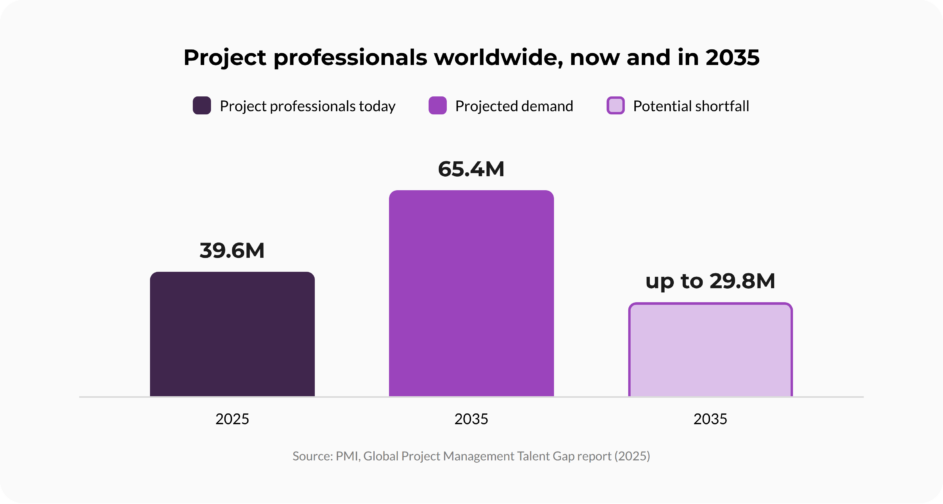
PMI estimates that there were approximately 39.6 million project professionals worldwide in 2025. By 2035, global demand could reach as high as 65.4 million, with a potential talent shortfall of up to 29.8 million project professionals.
That’s a much more current picture than older forecasts focused on project management employment through 2027.
And while job titles and ways of working will continue to evolve, organizations will still need people who can bring teams together, allocate limited resources, manage uncertainty, and turn plans into results.
Those are exactly the kinds of problems good project leads solve.
Frequently asked questions about project leads
What does a project lead do?
A project lead typically coordinates day-to-day project delivery. They may assign or coordinate work, track milestones, remove blockers, communicate progress, manage risks, organize resources, and help the team deliver agreed project outcomes. On larger projects, they may focus on one workstream and report to a project manager.
Is a project lead the same as a project manager?
Not always. Some companies use the terms interchangeably, but others distinguish between them. A project lead often focuses more closely on a team, workstream, or delivery area, while a project manager typically has broader responsibility for the overall project. Always check how the roles are defined within the specific organization.
Is a project lead higher than a project manager?
Not necessarily. A project lead may report to a project manager in one organization but hold broader responsibility in another. Neither title is universally more senior. Scope, accountability, decision-making authority, and reporting structure are better indicators of seniority than the title alone.
What are the main responsibilities of a project lead?
Common project lead responsibilities include team leadership, planning, coordinating tasks, tracking milestones, managing risks and issues, stakeholder communication, resource coordination, quality assurance, reporting, and problem-solving. Budget and scope responsibility vary by organization.
What skills make a good project leader?
Strong project leaders need leadership, communication, planning, organization, problem-solving, prioritization, stakeholder management, resource management, and adaptability. Domain or technical expertise can also be valuable, depending on the type of project.
Do you need PMP certification to be a project lead?
No. PMP certification can be a useful professional credential, but there is no universal rule requiring a project lead to hold it. Certification requirements depend on the employer and role.
How do you become a project leader?
Build practical experience delivering project work, learn project management fundamentals, develop communication and leadership skills, take responsibility for smaller projects or workstreams, and gain experience managing stakeholders, resources, risks, and schedules. Professional training or certification can support your development but isn’t the only route into the role.
Lead the project—not your team into burnout
Whatever your official title, successful project leadership is about more than keeping a task list up to date.
You need to know what has to be delivered, who can do the work, where your risks are, and whether the plan is actually realistic.
That gets much harder when resource information is spread across spreadsheets, calendars, and people’s heads.
Resource Guru gives project teams a shared view of schedules, availability, and workloads, making it easier to allocate work realistically and spot resource conflicts before they put delivery at risk.
Because great project leads don’t just ask, “Can we get this done?”
They ask, “Do our people actually have the time to do it well?”

The #1 scheduling and time tracking tool trusted by thousands of project teams
Join thousands of project managers who have made scheduling a breeze.
Last updated: October 16th, 2026