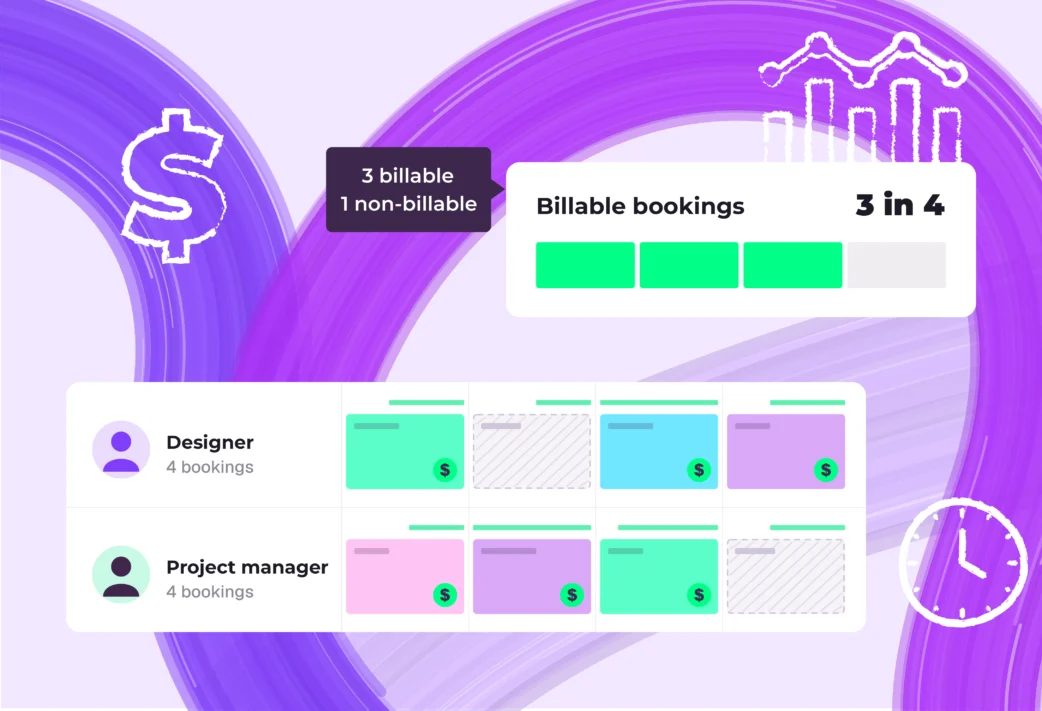
Based on recent analysis of over 590,000 bookings, Resource Guru’s data shows that about 3 in 4 bookings made in 2026 are billable. The other 1 in 4 bookings relate to work that no client pays for, including admin, winning new business, training, or client work you can’t charge for.
Here’s the part that’s the real thought provoking element: Teams place that unpaid work on their schedule anyway alongside billable hours. They plan for it, because it still requires people and resources in the same way as billable work.
For most project-based teams, billable hours are vital to growth and most advice tells you to squeeze in more of them. However, these recent findings show that if 1 in 4 bookings was never meant to be billed, then 100% billable was never the real goal.
So, the question is: “What does the ideal proportion of billable time look like?
In this article 📖
TL;DR
- About 3 in 4 bookings on team schedules are billable, based on Resource Guru data from January 2026 to November 2026
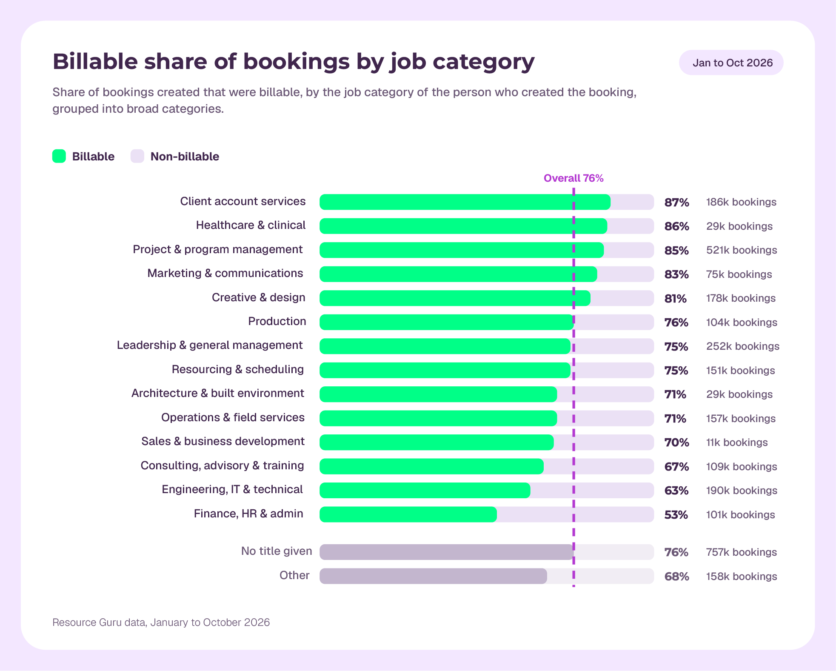
- People working in client account service roles mark nearly 9 in 10 (90%) of the bookings they create as billable
- People working in finance, HR, and admin roles mark about half of the bookings they create as billable
- Professional services firms averaged 66.4% billable utilization in 2025, the lowest in 19 years, according to SPI Research
- Your target, your plan, and your tracked time are three different numbers every team needs to keep an eye on.
What are billable hours?
Billable hours are the hours you spend on work a client pays for. Examples include: design work, client calls, or implementing the project they hired you to build.
Non-billable hours are classed as everything else. For example, team meetings, training, writing a pitch, fixing your own website, or the general, day-to-day running of the business. That work still matters immensely, but it’s not something you can put on an invoice.
Want to run your own numbers? Our billable hours calculator does the math for you.
How much scheduled work is billable?
As mentioned in the intro, about 3 in 4 bookings on team schedules are billable, according to Resource Guru data from January 2026 to November 2026. A booking is classed as a block of work someone puts on the schedule. When you add one in Resource Guru, you mark it as billable or non-billable.
The initial plan that’s created shows what teams are meant to do before the week falls into chaos and gets messy.
Our data tells the story that teams don’t plan a week that’s all client work. Instead, they leave room for the rest, and they do that on purpose.
Why does the billable share change by role?
The billable share swings a lot depending on who made the booking.
Resource Guru data, Jan 2026 to Nov 2026. Roles are the job category of the person who created the booking.
Picture the jobs and it makes sense. An account manager spends the day booking people for client projects. An office manager books training days, team events, and internal projects.
This shows who made the booking, not who did the work. It doesn’t imply an HR manager is half billable.
What it does say is how billable your company looks depends on where you stand. From the client side, the schedule looks close to 9 in 10 billable. Step back and it’s closer to 3 in 4. That’s a good reason to be careful with one billable target for every department.
Does the project plan match what gets billed?
Probably not, as the project plan tends to be the best case scenario. As work progresses, the tasks usually have to move.
Outside research shows how far the real number can fall. SPI Research surveyed 509 professional services firms for its 2026 benchmark. It fell to 66.4% in 2025, the lowest in the 19 years SPI has run the study.
Lawyers have it even harder. Clio’s 2026 Legal Trends Report projects that lawyers will record about 3.4 billable hours per 8-hour day in 2026. That’s 42% of the day. However, in 2016, it was 2.2 hours, so that’s actually an upward trend.
These studies don’t measure exactly the same data as we did, so you can’t line the numbers up side by side. But, they hint at a persistent gap between scheduled and billable hours.
So, where does the extra time go? A lot of it never lands on the schedule. Microsoft’s 2025 Work Trend Index found that more than half of meetings are unplanned calls with no calendar invite and happen at the drop of a hat. The busiest Microsoft 365 users get a meeting, email, or chat ping about every two minutes during the workday.
Nobody books that on the schedule, and nobody bills it either.
The 3 billable numbers to compare
Most teams keep track of one billable number. Try watching three instead. That way you’ll get insight into where your business and processes need most work to fix.
Use hours for all three, so you’re comparing like with like.
Here’s an example:
Say your target is 80%, and next month’s scheduled bookings are 70% billable. However, last month’s timesheets showed just 62% of time was actually billable.
That’s two gaps identified, and each one needs a different fix.
If your plan is below your target. The problem starts before the week does. You’re chasing a number that was never on the schedule. Maybe the target is too high. Or maybe there isn’t enough client work to book. Either way, working harder won’t fix it.
If your actual is below your plan. The real way the work played out ate up more time than expected, so look for the usual causes, like extra meetings, work that ran too long, and scope creep that nobody logged.
If all three match. This is the holy grail of scheduling! Now ask yourself a harder question. Is your non-billable time going to tasks that help you grow as a company and individual?
You can pull both the initial plan and the actual plan from one place if you compare scheduled time with timesheets. For the math behind the percentages, read our guide to billable utilization to give you a helping hand.
What should you do with the non-billable 1 in 4?
Always plan it in, never hide it.
Non-billable time pays for itself when you use it well. Specifically when you use it to train people, win new clients, and fix what slows you down as a business. A team that bills every hour has no time left to get better at anything.
Billing 3 out of every 4 hours (a 75% utilization rate) is widely considered the ideal benchmark for most service-based businesses, but ultimately it’s you who is best placed to analyze your own team and business.
The main issue is when that time is invisible to the team. If it isn’t on the schedule, you can’t see how much of it there is, therefore you can’t tell if it went to a pitch or got lost in a pile of pings.
Three habits change this:
- Put non-billable work on the schedule. Internal projects, training, and admin all take time so book them like client work
- Give it a name. “Non-billable” is a big bucket. Split it into a few types, like sales, training, and admin so you can see exactly where the time is spent
- Check it each month. Ask which types paid off and which ones you’d cut
Resource Guru lets you mark each booking as billable or non-billable, then see the split in your reports. Start your free trial and try it on your own team schedule.
Billable hours FAQ
What percentage of hours should be billable?
There’s no single right number, because it depends on the role, however a 75% utilzation rate is considered ideal. Resource Guru data backs up this claim. We found about 3 in 4 bookings on team schedules are billable. In SPI Research’s 2026 benchmark, professional services firms averaged 66.4% billable utilization in 2025.
What’s the difference between billable and non-billable hours?
Billable hours go to work a client pays for. Non-billable hours go to work the company pays for itself, like training, admin, and sales pitches.
Is 100% billable a good goal?
No. Nobody can bill every hour of the day as people need time for team meetings, training, breaks and other critical internal tasks. A plan with no room in it breaks the first time something overruns, and that’s how people end up overbooked and burned-out.
How do you calculate billable utilization?
Divide billable hours by total available hours, then multiply by 100. If you bill 30 hours in a 40-hour week, your billable utilization is 75%. Use our billable hours calculator to work this out for you.
How do you track billable hours?
Mark any work as billable or non-billable when you add it to your schedule. Then log the real time on a timesheet once the work is complete and compare the two to give you the outcome.
How we know
The Resource Guru numbers come from combined, anonymous booking data logged in Resource Guru from January 2026 to November 2026 from over 590,000 bookings. For every booking we counted whether each one was marked billable or non-billable. Roles come from the job category of the person who created the booking. We rounded the figures to show an aggregated view.
Secondary research sources we used:
- SPI Research, 2026 Professional Services Maturity Benchmark, press release published February 24, 2026
- Clio, 2026 Legal Trends Report, published 2026
- Microsoft, Breaking down the infinite workday, Work Trend Index Special Report, published June 17, 2025

The #1 scheduling and time tracking tool trusted by thousands of project teams
Join thousands of project managers who have made scheduling a breeze.
Last updated: 12th November, 2026.