


The Oxford English Dictionary has 21 definitions just for capacity. It’s a term used in many fields, from law to motoring to mechanics. Put simply, “capacity” means different things to different people, so it’s important to define what we mean by capacity planning before we can understand it properly.
For the purposes of this guide, we’ll be talking about capacity planning in terms of the people and equipment an organization depends on to deliver work.
Capacity planning helps organizations answer a crucial question: do we have enough overall capacity to deliver the work we expect to take on?
It connects future demand with the people and resources available to meet it, so leaders can decide whether to hire, outsource, invest, reprioritize, move timelines, or reduce/increase demand.
Given how many moving parts there are in this topic, we spoke to several individuals with first-hand, day-to-day experience with capacity planning to get their insights. You’ll find those peppered throughout.
Our panel of experts:
- Fahed Bitar, Project Executive at S-Line Contractors
- Stein Janssen, Chief Operating Officer at Poki
- Tetiana Hnatiuk, COO of Skylum
- Lucas Botzen, CEO of Rivermate
And, here are the main takeaways of this guide, in case you’re on a time crunch:
TL;DR
- Capacity planning compares future demand with realistic available capacity so organizations can spot potential shortages, surpluses, and bottlenecks before they affect delivery.
- Plan around effective capacity, not maximum capacity. Account for skills, leave, meetings, maintenance, existing commitments, and enough spare capacity to handle change.
- Different methods and strategies suit different situations. The right approach depends on factors such as demand certainty, resource constraints, flexibility, and how quickly capacity can be added or reduced.
- Review capacity plans regularly and measure their usefulness. Capacity gaps, utilization, forecast accuracy, bottlenecks, and delivery performance can show where planning can be improved.
Before we get into the steps involved, examples, and best practices in depth, let’s elaborate a little on our initial definition of capacity planning to set the stage.
In this article 📖
What is capacity planning?
As defined in our resource and project management glossary, capacity planning is a long-term, strategic process that determines the overall capacity an organization needs to meet future demand and goals.
That usually means looking across the organization at people, roles, skills, working time, and equipment, then comparing that capacity with expected projects, clients, and initiatives.
We touched on this, but capacity planning can also apply to storage, networks, or infrastructure, but this guide focuses on the type of capacity we’ve identified because that is most relevant to project-based teams.
What’s the difference between capacity planning, resource capacity planning, resource scheduling, and capacity management?
If you’re just starting to learn about capacity planning, you might notice a lot of related terms and they might cause some confusion. While the following concepts might sound similar, there are some important distinctions to remember when considering each one.
The easiest way to remember what the terminology means is to think about its applications, and the question each one answers:
Term | How to think about it | Typical question it answers |
Capacity planning | A higher-level, longer-term organizational assessment of whether overall resource capacity is sufficient for future demand and goals | “Do we have enough people, skills, time, and equipment overall?” |
Focused more specifically on the capacity of particular teams, departments, or resources against planned workload | “Does this team have enough suitable availability?” | |
Identifying the people, skills, equipment, and other resources a plan requires | “What resources will this work need?” | |
Scheduling when the people will do the work for the tasks or projects over time, to meet specific goals, milestones, and deadlines | “When can the work happen?” | |
Capacity management | Monitoring and adjusting capacity over time | “Are demand and capacity staying in balance?” |
Further reading: This article focuses on the organizational level when it comes to capacity. For detailed insights on the team and project workload level, see our resource capacity planning guide.
Components and elements of capacity planning
Capacity planning can be a very involved process but, if we break it down to the basics, each model typically includes at least some of the following components and elements:
Component | What to define |
Demand | Committed, probable, possible, and seasonal, plus an allowance for unplanned demand |
Total capacity | The theoretical maximum output under ideal conditions |
Effective capacity | The output that can reliably be planned after normal losses and constraints such as leave, maintenance, meetings, and other predictable unavailable time |
Constraints | The role, skill, asset, supplier, approval, budget, or system that limits output |
Uncertainty | Expected, high-demand, low-demand, and disruption scenarios |
Decision rules | The choice of when to hire, outsource, delay, reduce scope, or stop accepting work |
While identifying and monitoring any (or all) of these capacity planning components can seem like a lot of work at first, it tends to be worth the effort. See the evidence in the next section.
Advantages and disadvantages of capacity planning
Having read this far, you might think that there are no downsides to capacity planning. It’s just logical to understand if you have enough capacity to match up with expected demand, right?
Well, theoretically, yes, but there are other factors worth considering that can make poorly executed capacity planning a disadvantage for your business. But, let’s touch on the upsides first.
Advantages of capacity planning
The main benefits of capacity planning are:
- Realistic commitments: Plans that are grounded in reality mean less timeline slippage and improved project delivery
- Earlier investment: Hiring, equipment, facilities, suppliers, and technology acquisition can be addressed before a constraint becomes urgent—or eats into budget
- Better portfolio choices: Leaders can compare demand scenarios before approving competing commitments
- Visible bottlenecks: Analysis shows which role, asset, stage, or dependency limits output and gives you a heads up on what needs addressed
- Deliberate buffers: Spare capacity covers iteration, quality, recovery, and unplanned demand so that one unexpected change doesn’t affect all initiatives
- Lower burnout risk: Growth is less likely to depend on unsustainable workloads
Further reading: Explore our burnout risk index to see contributing factors and which groups are most susceptible.
Stein agrees on the importance of rigorous capacity planning, and notes that the operational impacts appear quickly:
“Once a team overcommits their resources, the effects of doing so will quickly start to appear. Examples include: roadmaps become reactive, the details lost in hand-offs increase significantly, the process of determining priorities becomes very emotional; and most importantly, Managers spend far too much of their time “fighting fires” versus helping improve the operational rhythm of the team.”

Disadvantages of capacity planning
- Forecasts can be wrong and lead to unrealistic expectations
- Detailed models can be costly to maintain, both in terms of people power and infrastructure costs
- Plans can also create false confidence or be misused to push people and assets toward 100% utilization, which is unsustainable
Lucas recommends always leaving buffer time for the less visible work that can misrepresent true capacity, unless it’s baked into your calculations:
“This experience dramatically impacted my thinking related to forecasting, and I significantly improved upon my discipline to consider factors including meetings; support work; vacation time; on-boarding activities; and unforeseen delivery risks while developing my forecasting models.”

With that in mind, let’s move into practical applications of capacity planning, starting with a general overview of the steps involved.
How to do capacity planning
Capacity planning starts by comparing the demand you expect with the capacity you can realistically rely on. From there, the goal is to identify gaps early enough that you still have options for addressing them.
A simple capacity planning procedure
- Define the planning horizon. Decide how far ahead you need to plan. That might be the next few weeks, quarter, year, or longer depending on how quickly your organization can hire people, buy equipment, or otherwise change capacity
- Estimate future demand. Compile information about the projects, clients, initiatives, and other work you expect to take on. Where demand is uncertain, separate committed work from probable and possible work rather than treating every forecast as equally certain
- Calculate available capacity. Assess the people, skills, working time, equipment, and other resources you expect to have available. Use effective capacity rather than assuming every theoretical working hour or unit of equipment can be fully utilized
- Compare demand with capacity. Look for periods, roles, skills, or resources where demand exceeds capacity, as well as areas where capacity may go unused. The overall numbers matter, but so do individual constraints: having enough people in total won’t help if you’re short of a critical skill
- Test different scenarios. Consider what happens if demand is higher or lower than expected, a project moves, someone leaves, or new capacity takes longer to secure. Scenario planning helps you understand which assumptions have the biggest effect on the plan
- Decide how to close the gaps. Depending on the situation, that could mean hiring, outsourcing, investing in equipment, reallocating people, changing timelines, reducing scope, or declining work
Capacity planning isn’t usually a one-and-done exercise. Revisit the plan as demand, availability, and organizational priorities change so that decisions continue to reflect reality.
As well as taking that tip into account, there are several other tried-and-true recommended principles to keep in mind through your capacity planning journey. Let’s check those out next.
Capacity planning best practices
A useful capacity plan should help you make better decisions, not simply produce a more detailed forecast. These best practices can help keep the process grounded:
- Plan around effective capacity, not theoretical maximums. Account for meetings, leave, administration, maintenance, training, and other work that reduces the capacity you can reliably commit
- Plan for skills as well as headcount. As mentioned, ten available people don’t necessarily represent useful capacity if the work requires expertise only one of them has
- Build in some resilience. Planning everyone or everything at 100% utilization leaves little room for delays, urgent work, quality issues, or changing priorities
- Separate certainty levels in your demand forecast. Committed, probable, and possible work should not necessarily drive the same capacity decisions
- Pay attention to bottlenecks. Overall capacity can look healthy while a particular role, approval, asset, or supplier limits what the organization can actually deliver
- Match the level of detail to the decision. Long-term planning rarely needs individual tasks scheduled hour by hour. Start at a level that helps leaders make decisions, then add detail where a constraint requires it
- Review assumptions regularly. Forecast accuracy, hiring lead times, productivity, availability, and demand can all change. A capacity plan becomes less useful when its assumptions stop reflecting current conditions
Above all, avoid treating maximum utilization as the objective. Good capacity planning should create enough capacity to deliver expected work sustainably while retaining the flexibility to respond when the forecast proves inaccurate.§
How to gauge whether capacity planning is working
The goal of capacity planning isn’t simply to make demand and capacity match perfectly on a spreadsheet. It also helps your organization make earlier, better-informed decisions about what you can realistically deliver.
Useful capacity planning KPIs and metrics include:
Measure | What it can tell you |
Utilization | How much effective or workable capacity is being used, and whether particular teams or resources are consistently overloaded or underused |
Capacity vs. demand | Whether total expected demand can be supported by effective capacity over the planning period |
Capacity gap | The difference between available capacity and additional required capacity, ideally broken down by role, skill, team, or equipment type |
Forecast accuracy | How closely forecast demand and capacity assumptions match what actually happens |
Delivery performance | Whether capacity-related delays, missed deadlines, or changes to commitments are becoming more or less frequent |
Bottleneck frequency | Whether the same roles, skills, assets, or stages repeatedly constrain delivery |
Unplanned capacity interventions | How often the organization has to rely on emergency hiring, overtime, outsourcing, or last-minute reprioritization |
No single metric proves that capacity planning is working. Monitor a combination of leading indicators, such as capacity gaps and utilization, alongside outcomes such as delivery reliability and the frequency of last-minute interventions.
More advanced organizations may also use capacity planning algorithms and predictive analysis to identify patterns, forecast future requirements, or model alternative scenarios.
Whatever the level of sophistication at your place of work, the objective remains the same: give decision-makers enough warning to act before a capacity constraint becomes a delivery problem.
Capacity planning methods and methodologies
As you might know, there are many different approaches to capacity planning, and no single approach is a one-size-fits-all. The best way to figure out what will work best for your specific set of circumstances is to examine what the options are and map the best fit to your needs.
In this section we’ll talk about methods and methodologies for capacity planning and, in later sections, we’ll dig into popular named strategies. Terminology varies between industries and planning systems, but common capacity planning approaches include the selection in the table below.
Approach | What it does | Best for |
Rough-cut capacity planning (RCCP) | Tests whether a high-level plan is feasible against critical team member or resource capacity | High-level feasibility checks, particularly where a few critical people or resources constrain delivery |
Simulation and scenario planning | Tests alternative futures | Environments with high uncertainty or expensive hiring decisions |
Aggregate capacity planning | Compares broad groups instead of named individuals | Department or quarterly planning |
Finite capacity planning | Respects hard limits and exposes conflicts | Organizations with scarce specialists or equipment |
Infinite capacity planning | Loads all demand without enforcing limits | Revealing all expected pressure on people and resources |
Dynamic capacity planning | Updates as forecasts and availability change | Volatile project environments |
Elastic capacity planning | Adds or removes capacity as demand changes | Contractors, freelancers, partners, or rented equipment |
Predictive capacity planning | Uses history, forecasts, capacity planning algorithms, and analysis to anticipate bottlenecks | Data-rich organizations |
Capacity planning strategies
While you might use a methodology as a way of thinking about capacity planning in general, and a method to execute it, a capacity planning strategy involves making a careful, high-level plan designed to achieve a long-term goal in relation to capacity.
In that sense, it can involve a mixture of methods and methodologies, which is one logical way to think about the distinction between those and “strategy.” In this section, we’ll discuss some of the most popular options.
Strategy | Approach | Main trade-off |
Lead strategy | Add people or equipment before demand is confirmed | Faster response, more unused-capacity risk |
Lag strategy | Add capacity after demand is proven | Lower carrying cost, more delay risk |
Match strategy | Add capacity in smaller increments | Balanced risk, regular monitoring required |
Level strategy | Keep capacity stable and smooth, queue, or decline demand | Stable teams, but some work waits |
Lean capacity planning | Improve flow without removing necessary resilience | Efficient, but too little slack is fragile |
Just-in-time capacity planning (JIT) | Matches work output directly to real-time client demand | Lower idle-capacity cost, but dependent on quick access to additional capacity when the need arises |
Mixed strategy | Use different approaches for different constraints | Flexible, but more complex |
Team-level techniques that support capacity planning
Strategy | Approach | Main trade off |
Scrum capacity planning | Set capacity for each sprint (usually less than one month) based on team availability, historical velocity, and the work the team can realistically commit to | Predictable short-term planning, but less flexible once a sprint begins |
Agile capacity planning | Reassess and adjust capacity iteratively as priorities, demand, and team availability changes | Highly adaptable, but requires frequent replanning and reliable visibility into capacity |
Kanban capacity planning | Visualize demand (often on a Kanban board) and use WIP limits to pull new work only when capacity becomes available | Reduces overload and exposes bottlenecks, but excess demand must wait for capacity |
Further reading: A reminder that, for more details on team-level capacity planning, you can consult our resource capacity planning guide.
As well as the tradeoffs we’ve listed, we spoke to experts working in the capacity planning space daily. Here are their picks when it comes to the most useful strategy, and why.
Fahed favors matching capacity to evidence:
“The match strategy is what I come back to consistently. It matches resources to actual demand and not to expected need.”

Tetiana uses a blended approach:
“We prefer to rely on a combination of the ‘match’ and ‘level’ strategies. In software development, using only forecasts of future demand creates burnout.”

Next we’ll tackle the math you need to pull off any of these strategies by exploring helpful formulas and calculations.
Capacity planning formulas and calculations
Regardless of which methods, methodologies, or strategies you employ when it comes to capacity planning, you’ll always need to calculate capacity at one stage or another.
Below are four useful examples that apply regardless of which capacity planning approach you choose:
- Available capacity – A useful overall indicator of the uncommitted capacity you have at any given time
- Available capacity (equipment) – A riff on the previous formula specifically for non-human resources
- Capacity gap – A simple but effective way to see how far off your current capacity is from where you need it to be
- Billable utilization rate – Not strictly limited to capacity, but billable utilization shows you how much workable capacity is being spent on billable activity and can highlight opportunities to use that capacity more effectively
Available capacity formula
Available capacity is the capacity you have left after accounting for predictable unavailable time and work that has already been committed.

Available capacity = Total working time – Predictable unavailable time – Existing commitments
Predictable unavailable time might include planned leave or other time when someone cannot take on work. Existing commitments are the projects, tasks, or other work that have already been allocated.
The resulting figure shows how much capacity remains available for additional demand.
Available capacity formula (equipment)
The same principle can be applied to equipment by accounting for planned downtime and time that has already been booked.
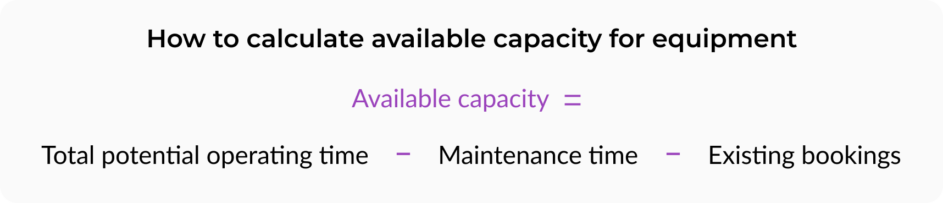
Available capacity (equipment) = Total potential operating time – Maintenance time – Existing bookings
This shows how much equipment capacity remains available for additional work.
Capacity gap formula
Once you know your available capacity, you can compare it with the capacity needed to meet additional demand.
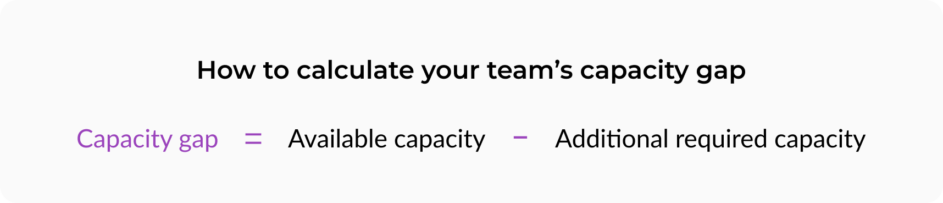
Capacity gap = Available capacity – Additional required capacity
Here, additional required capacity means the capacity needed to meet demand that is not already accounted for in existing commitments.
A positive gap suggests spare capacity; a negative gap means additional demand is greater than the capacity currently available to meet it.
Billable utilization rate formula
Billable utilization shows how much workable time is spent on billable work.

Billable utilization (%) = (Total billable hours/Total workable hours) x 100
Here, total workable hours means scheduled working time after non-working time such as leave, holidays, and absence has been excluded. It still includes non-billable working activities such as administration, internal meetings, training, and documentation.
This is different from available capacity: available capacity tells you how much capacity remains uncommitted, while billable utilization shows you how much workable capacity is being spent on billable activity, and can highlight opportunities to use that capacity more effectively.
When asked what “ideal” billable utilization looks like, Stein from Poki recommends dedicating 20-30% of hours to non-billable time:
“I generally look for billable/delivery utilization levels ranging from 70% to 80%. Any higher than this, I typically believe that a company is taking time away from some area such as quality, documentation or recovery.”
— Stein Janssen
Capacity planning FAQs
What is capacity planning in project management?
Capacity planning in project management is the strategic process of determining whether an organization has enough people, skills, working time, and other resources to meet expected project demand.
It helps identify future capacity gaps or surpluses before they affect delivery.
What are the different types of capacity planning?
Capacity planning can use methodologies such as dynamic, elastic, finite, and infinite planning, depending on how an organization chooses to respond to demand and resource constraints.
Methods such as rough-cut capacity planning and simulation can then be used to assess requirements, test scenarios, and identify capacity gaps.
What considerations should I take into account when it comes to capacity planning?
Capacity planning should consider expected demand, available people and equipment, skills and roles, working hours, utilization, planned leave, project priorities, and the time required to add or reallocate capacity.
It should also account for uncertainty in forecasts and how quickly the organization can respond when demand changes.
What factors affect capacity planning?
Capacity planning is affected by changes in project demand, workforce availability, employee skills, productivity, working patterns, equipment or infrastructure, project schedules, and organizational priorities.
External factors such as client demand, labor market conditions, supply constraints, and unexpected disruptions can also change the amount of capacity required or available.
What are the tradeoffs in capacity planning?
The main tradeoff in capacity planning is between maintaining enough spare capacity to absorb demand changes and maximizing utilization to control costs.
Too little capacity can cause delays, overwork, and lost opportunities, while too much capacity can result in underutilized people, equipment, and unnecessary costs.
How to get started with capacity planning
If you’re ready to put what you’ve learned about capacity planning in this guide into practice, dedicated capacity planning software can help provide the clarity, control, and flexibility you need to execute on any of the methods, methodologies, and strategies.
Start a free trial of Resource Guru is just a few clicks—no credit card needed:

The #1 scheduling and time tracking tool trusted by thousands of project teams
Join thousands of project managers who have made scheduling a breeze.