

Only half of projects succeed, delivering value that exceeds the effort and expense involved, according to PMI’s 2025 global study of 5,800+ professionals. The rest either fall short or fail outright. For teams where every hour is billed and every missed deadline costs client trust, that success rate first hinges on the planning stage.
This article and asset are for project managers, studio managers, and operations leads who need a practical tool now to help on that front. Download our two-in-one free Excel project plan template (including a task-list view and a Gantt chart) then work through the step-by-step setup guide to build your plan and adapt it to your project.
In this article 📖
Your Excel project plan template at a glance
- The template includes task names, phases, assignees, start dates, end dates, a status dropdown (not started/in progress/complete/overdue), as well as an auto-calculated duration field
- The task-list is a flat table; the Gantt chart template in the next tab adds a conditional-format timeline that updates automatically from the task list
- The template is free to download as an .xlsx file or to use in Google Sheets; no sign-up or account required
- This Excel project plan template is best suited to projects with clearly defined phases, named task owners, and fixed delivery deadlines
- The Gantt tab of this Excel project plan template is useful when project phases overlap, or when you need a basic, shareable visual timeline for client updates or stakeholder reviews
- Team availability, utilization, and scheduling conflicts across concurrent projects are note included in these templates. See “When it stops working” for when to try something more sophisticated
Download your free Excel project plan templates
The template lives on Google Sheets for ease of online access. To download it for Excel, simply Make a Copy, and go to File → Download → Microsoft Excel. You’ll then have access to multiple tabs: the task-list view for day-to-day tracking, and the Gantt chart view for timeline visualization. All free of charge, no account needed.
→ Download your free project plan template
Simple project plan template
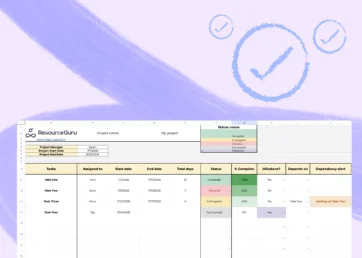
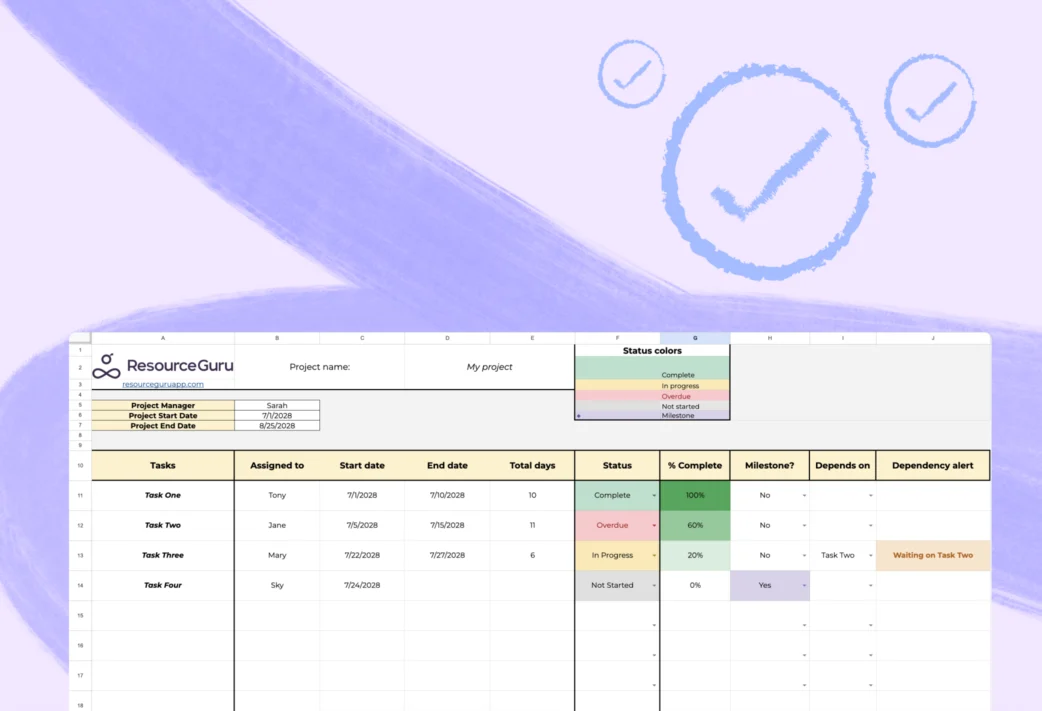
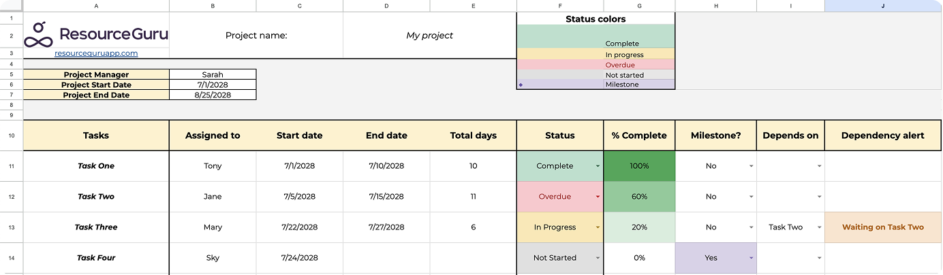
The task-list template tab organizes your project as a flat table, one row per task. Each row captures:
- Task name
- Phase
- Owner
- Start date
- End date
- Status dropdown (not started/in progress/complete/overdue)
- Completion percentage
The template also calculates a total days field automatically from your date entries.
Use this template for projects with sequential phases. For example, an agency may be tasked with establishing a brand identity, building a site, a paid media campaign, or any engagement where work runs in order, rather than in parallel. The template stays most legible at smaller project sizes, and it takes under a minute to update in a weekly review.
Project plan with a Gantt chart
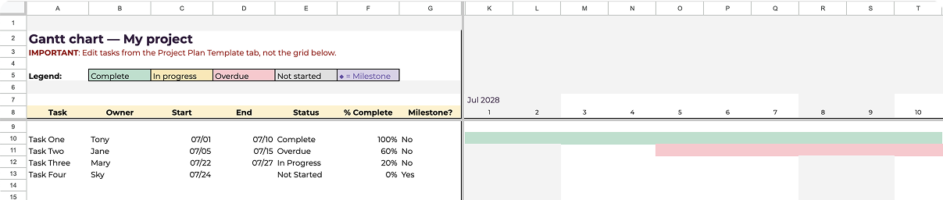
There’s a simple Gantt chart in an additional tab in the template file. Task names, owners, start dates, end dates, and status get pulled from the task-list tab.
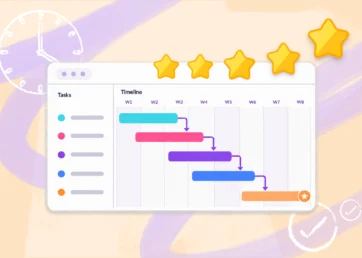
The Gantt view draws conditional-format bars across a calendar timeline. Each task’s bar spans its start and end dates, and progress shading updates as you mark work complete or in progress in the task-list tab.
Use the Gantt version when phases overlap, when you need a shareable timeline for client reviews, or when your team benefits from seeing the task timeline visually. The chart updates as the task list changes, and there are no formulas to write.
Choosing the right template for your project type
Choose based on project structure and who needs to see the plan.
- Linear campaigns: Task-list template only. Think a brand refresh, content sprint, or paid media launch fits the flat structure cleanly
- Construction or infrastructure: Focus on the Gantt chart template. Phases typically overlap; the timeline view makes sequencing, handoffs, and phase dependencies visible at a glance
- IT and software development: Prioritize the Gantt chart template. Monitor phase rows to keep an eye on sprints, milestones, or agile cycles, and communicate delivery windows while keeping the full plan to the people who need it
- Marketing retainers: The task-list template is best for ongoing monthly work. The Gantt chart template is more helpful for project-specific deliverables with defined start and end dates
- Website launches: Lean on the Gantt chart template. Discovery, design, build, content, QA, and launch often run in parallel, so this view is pest. The timeline will highlight date conflicts before they become deadline problems
Of course, you can use both tabs on one project: the task list for daily tracking, the Gantt tab for forward planning.
What’s inside the template
The .file contains two tabs: the task-list view and the Gantt chart view. The Gantt chart view pulls data from the task-list view.
Here’s some more info on what to include in each task list column:
- Task name: A verb-led description of the work (for example: “Review and approve homepage design”)
- Phase: The project stage this task belongs to, used to group rows and create a visual hierarchy
- Task owner: One named person per task; the person accountable for completion
- Start date and end date: Entered manually; the total days field calculates from these automatically
- Status: A dropdown with not started, in progress, complete, or overdue
- Total days: Calculated automatically from start and end dates
As we’ve mentioned, the Gantt chart tab takes information from the start and end date columns and draws conditional-format bars across a calendar timeline. Progress shading updates as task status changes.
The template covers tasks and timeline. To track spend alongside your plan, use our project budget template.
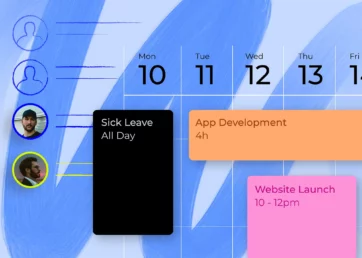
In a tool like Resource Guru, you can compare Gantt chart plans to your team’s actual availability and capacity on a dedicated schedule. That way you can close the gap and connect each task to whoever’s actually free to do the work, across every project in your portfolio.

Plan with Gantt charts. Deliver with smart scheduling.
Join thousands of managers using Resource Guru to plan projects and schedule people in one place.
How to build a project plan in Excel
Make a copy of the template, download it as a Microsoft Excel file or work online in Google Sheets, then fill in the task columns as you work through each step. The Gantt chart updates automatically once dates are in place.
Step 1: List tasks
Enter every piece of work in the task name column, using verb-led descriptions for clarity: “Design homepage wireframe”, not “Homepage”.
Keep task scope consistent. Break large tasks down until each one represents an ownable unit of work that’s specific enough that a single person can track, complete, and mark it done.
Step 2: Assign owners, start dates, and end dates
Enter one owner per task. This should be the single person responsible for delivery, even if they are collaborating with others on the task. Split a task into two or more separate tasks if it cannot legitimately have a sole person responsible for it.
Add a start date and end date for each task. The template calculates the total days field automatically. For tasks that depend on another finishing first, align the start date with the expected completion of its predecessor. On the Gantt chart tab, the sequence becomes visible. You can also mark tasks as milestones.
Step 3: Track status, progress, and dependencies
Update the status dropdown weekly using the four options: not started, in progress, complete, or overdue. On the Gantt chart tab, progress shading reflects task status, giving you a visual read on where the project stands without scanning every table row.
Flag tasks that block others directly in the dependency column and dependency alert column. A task marked overdue with downstream dependencies needs immediate attention. The status field holds value only when the team updates it consistently and acts on what it shows.
Step 4: Review and update weekly
Set a fixed weekly review cadence (for instance, 15 minutes before or after your team’s standing check-in). Update every status, adjust any dates that have slipped, and reassess the plan if the original timeline is no longer realistic.
A project plan is only useful when it’s current, after all. Stale dates and optimistic statuses give stakeholders false confidence and leave the team guessing about what to prioritize. The weekly update is the best time to set consistently realistic expectations.
When an Excel project plan template stops working
Excel project plans work well for a single project with a stable team. They start to break down as complexity grows.
Common breakpoints:
- Multiple concurrent projects: Task status across five project files shows where each project stands; whether the team can deliver them all on schedule is a separate capacity question the spreadsheet leaves open
- Clash detection: Book the same person in two separate project files and the spreadsheet shows both as fine. You’ll only find out the truth at standup, when it’s already a problem
- Leave and availability: Vacations, reduced hours, and existing bookings on other client work all sit outside what Excel tracks
- Version control: Shared Excel files multiply (v2, v3, FINAL_FINAL), especially on agency engagements with multiple stakeholders

See how Spindogs boosted billable time and saved hours every week by switching from spreadsheets to Resource Guru.
- Our capacity planning template is a useful intermediate step when you’re ready to add availability into the picture.
- For teams managing multiple concurrent projects with shared people, our resource scheduling template adds the availability layer a plain spreadsheet leaves out.
Frequently asked questions
Does Excel have a project plan template?
Excel’s built-in library does not have a project plan template or timeline view. Microsoft Create offers general planners, but most teams use a purpose-built download like the free one on this page with Gantt chart functionality and status tracking already configured.
How do I create a project plan template in Excel?
An Excel project plan template starts with a table: task name, phase, owner, start date, end date, and status. For a Gantt chart view, apply conditional formatting to draw bars across the date range, or use a template like the one provided here.
How do you use an Excel project plan template?
You use an Excel project plan template by downloading the file to your device, or by adding it to a shared drive. You can then add tasks, assign owners, enter dates, and update the status dropdown as work progresses. One person should own the master file, since shared copies diverge quickly.
How do you write a project plan in Excel?
Writing a project plan in Excel starts before the spreadsheet: identify deliverables and phase boundaries first. Then enter tasks by phase, assign one owner per row, add start and end dates, and track progress with the status field.
From plan to schedule: Resourcing the work
A project plan defines what needs to happen and when. Whether your team has the capacity to actually deliver it is a separate question.
That gap between what the plan requires and what the team can realistically produce is where projects slip. An Excel template maps the expected timeline, but a task owner who’s fully booked elsewhere or on vacation during a critical build phase sits off the page entirely.
Resource Guru is project planning software that brings Gantt charts and team scheduling together in one place. See how our Gantt charts connect your project timeline to real team availability and turn a plan on paper into one that can actually be delivered.
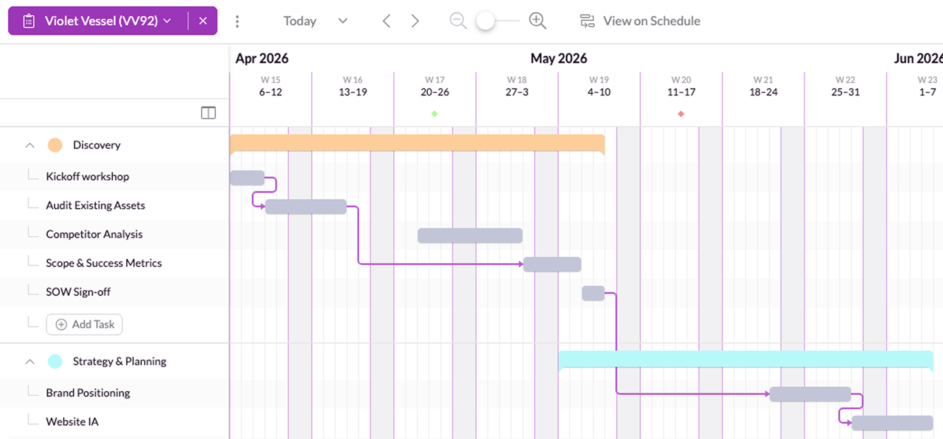
If your team runs multiple projects with shared people, explore our capacity planning software to see where utilization is running hot, before it burns the project to the ground.
All details accurate as of September 9, 2026.

The #1 scheduling tool trusted by thousands of project teams
Join thousands of project managers who have made scheduling a breeze.